Xander Fisher headshot

Team SPG coach

Xander Fisher

Operations Coach, Team SPG

Xander has 8 years of experience in the Plumbing, Sewer, Electrical, and HVAC industry. He got his start as a CSR and has taken on other roles as a Dispatcher, Inside Sales Representative, Call Center Manager, and Internal Operations Manager. He comes from a Central Ohio company where he helped create, grow, and document several processes, systems, KTIs, and best practices that helped the company from go from $8 million to $75 million in revenue. Overall, Xander is passionate about well documented and efficient procedures, visible KTIs for all employees, and pushing innovation. He loves helping people grow and watching them reach their goals and dreams.

  • HVAC contracting
  • Service pricing and billable hours
  • Electrical contracting
  • Scaling a home service company
  • Plumbing contracting

Articles by Xander (9)

How-to

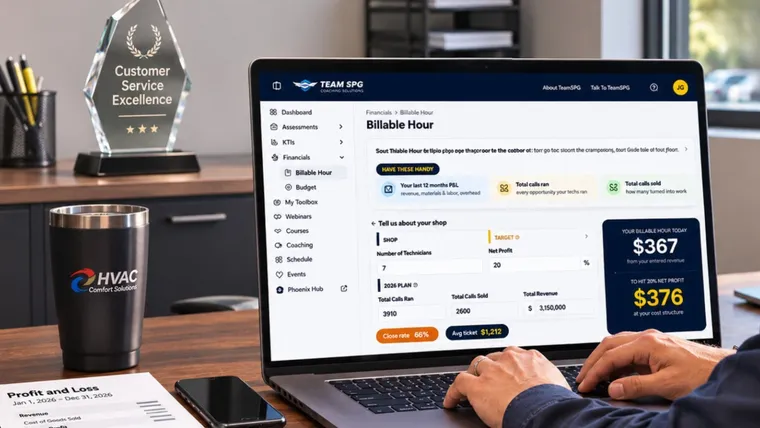
What should my billable hour rate be? (HVAC)

Your billable hour rate must cover your shop’s costs and leave your planned profit. Divide total yearly costs by one minus your profit goal, written as a decimal. Then divide by planned billable hours. Use hours your techs can bill, not every hour you pay them for.

Updated 4 min read

How-to

What KPIs should I track while scaling my electrical business past $1M?

Track total revenue, conversion, average ticket, maintenance plan conversion, and callback rate. Keep using your shop averages as you add trucks. Compare each tech with those averages and your company goals. Then use their daily KTI results to decide what to coach and check whether that coaching works.

Updated 3 min read

How-to

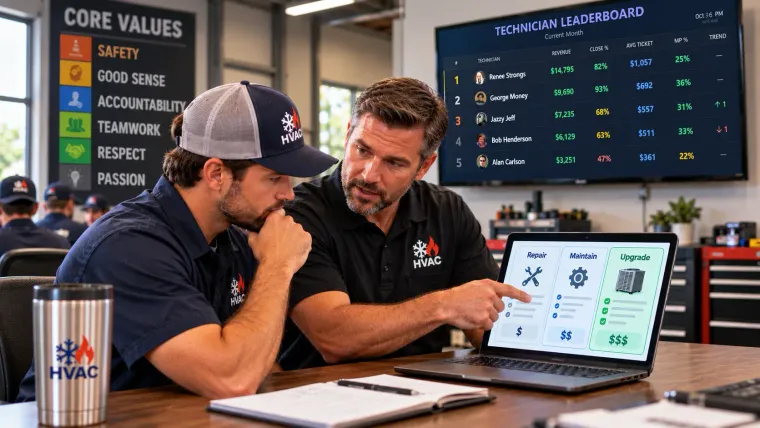
Why do some HVAC techs close more calls than others?

At coached HVAC shops, the bottom quarter of techs close 52.6% of their calls or less. The top quarter close 83.7% or more. They run the same kinds of calls for the same kinds of customers. The difference is not talent. Top techs follow the same steps, in the same order, on every call.

Updated 5 min read

Benchmark

What's the average close rate for an HVAC tech?

No single average close rate works for every HVAC shop. A useful comparison starts with the calls your techs run and who handles system sales. Compare techs with similar duties, then review their full KTI. Use revenue per truck to check overall productivity, rather than judging the shop by close rate alone.

Updated 3 min read

Benchmark

What's the average close rate for a plumber?

The median plumbing tech sells 73.6% of the calls he runs. Techs in the bottom 25% close 66.3% or less. Techs in the top 25% close 81.9% or more. Your trip charge, your mix of demand and estimate calls, and how many members you serve all move this number.

Updated 4 min read

How-to

How do I increase profit margin in my plumbing business?

Profit margin goes up when you cut waste, stop leaks, and make every dollar count. Most owners chase more revenue, but that can hide problems. The Service Operating System (SOS) brings clarity. It shows you where money leaks out and gives you tools to fix it. Clarity is what builds profit.

Updated 4 min read

How-to

How do I make my HVAC business run without me?

Your business runs without you when the questions that interrupt your day have a written answer instead of your phone number. You don't need to document everything — a few short, written rules cover most of what actually reaches you. Start with three systems: how calls get booked, which job gets the truck first, and…

Updated 4 min read

How-to

When should I hire another plumber?

Hire before it feels comfortable. A producing tech at a coached shop generates $566K a year, and if you have an open truck it can't earn that while it's empty. Most owners wait for the month where the money is obviously there, which is the same month their crew is already past capacity and their customers already…

Updated 4 min read

Reviewed by Xander (1)

Benchmark

What's a good average ticket for an electrical service call?

At electrical shops that track technician performance daily, the median average ticket — total revenue divided by sold jobs, per tech — is $1,511. The middle half of techs run between $834 and $2,114. If your shop's number lives near the service-call fees you see quoted online, you're leaving most of the job on the…

Updated 2 min read

All articles