Team SPG Resources

Home Service Business Guides

Benchmarks, pay plans, pricing, and operations guidance for owners of residential plumbing, HVAC, and electrical companies — built from real numbers reported by shops like yours, not survey guesses.

23 articles3 topics3 tradesLast updated November 9, 2026

Latest guides

How-to

What should my billable hour rate be? (HVAC)

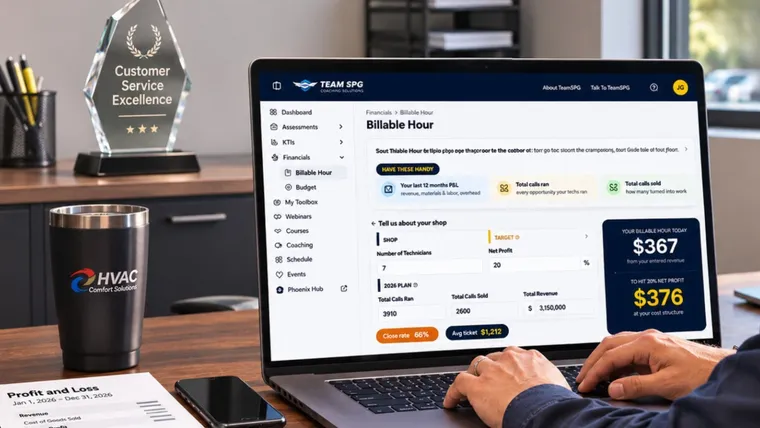
Your billable hour rate must cover your shop’s costs and leave your planned profit. Divide total yearly costs by one minus your profit goal, written as a decimal. Then divide by planned billable hours. Use hours your techs can bill, not every hour you pay them for.

Updated 4 min read

How-to

What KPIs should I track while scaling my electrical business past $1M?

Track total revenue, conversion, average ticket, maintenance plan conversion, and callback rate. Keep using your shop averages as you add trucks. Compare each tech with those averages and your company goals. Then use their daily KTI results to decide what to coach and check whether that coaching works.

Updated 3 min read

How-to

What KPIs should I track while scaling my HVAC business?

There are a lot of KPI's that could and should be tracked. Fortunately there are a few we really want to pay attention to as an HVAC shop. Its very important as well to understand that you need to track KPI's not just for the business over all, but your key verticals. One KPI that you will want t o track is your close…

Updated 6 min read

How-to

Why do some HVAC techs close more calls than others?

At coached HVAC shops, the bottom quarter of techs close 52.6% of their calls or less. The top quarter close 83.7% or more. They run the same kinds of calls for the same kinds of customers. The difference is not talent. Top techs follow the same steps, in the same order, on every call.

Updated 5 min read

How-to

When should I hire a general manager for my electrical business?

It's time to hire a General Manager when you are ready to turn over the reigns of the business. Hire a general manager when daily problems take most of your week and when you can afford it. Your techs need to sell enough to pay for the additional overhead salary, on top of what you deserve as the owner of the…

Updated 7 min read

Benchmark

What's the average close rate for an HVAC tech?

No single average close rate works for every HVAC shop. A useful comparison starts with the calls your techs run and who handles system sales. Compare techs with similar duties, then review their full KTI. Use revenue per truck to check overall productivity, rather than judging the shop by close rate alone.

Updated 3 min read

Browse by trade

Browse by topic

Foundation

Goals, systems, and the numbers every owner should know before anything else.

Revenue & Performance

Close rates, average tickets, pay plans, and the levers that move daily revenue.

Scalability

Adding trucks, managers, and locations without losing the wheels.

Meet the coaches

Guides to SOS, Free Software for the Trades

Running your shop on SOS

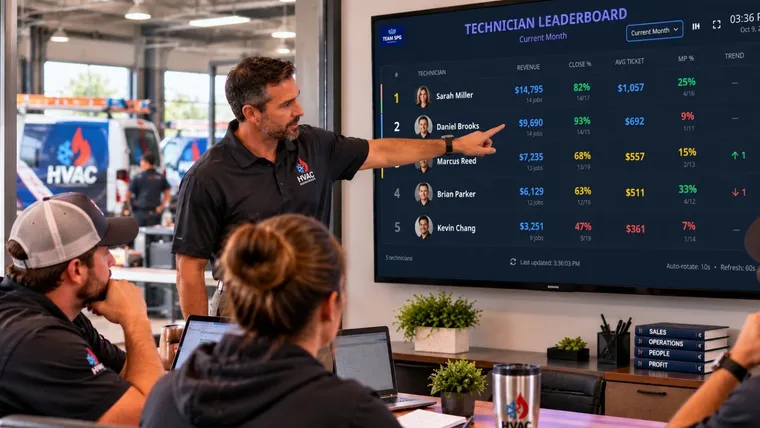
How to use the free Service Operating System: the TV leaderboard, daily KTIs, budget, courses, and assessments, and how it compares with other software.

Every guide

Plumbing

  • What's the average close rate for a plumber?

    The median plumbing tech sells 73.6% of the calls he runs. Techs in the bottom 25% close 66.3% or less. Techs in the top 25% close 81.9% or more. Your trip charge, your mix of demand and estimate calls, and how many members you serve all move this number.

    Updated

    Revenue & Performance
  • How do I grow my plumbing business past five trucks?

    There is no five-truck hump, at least its not a physical limitation. There is a productivity band, and it decides everything. At coached plumbing shops the middle half of technicians produce somewhere between $350K and $553K a year. Multiply either end of that band by five trucks and you get two companies that are not…

    Updated

    Scalability
  • What's a good average ticket for a plumbing service call?

    A good average ticket for a plumbing service call runs between $892 and $1,805. The middle of the pack sits at $1,213. That range only holds up if you count the number the same way we do: sold revenue divided by number opportunities ran, tracked by tech.

    Updated

    Revenue & Performance
  • How do I increase profit margin in my plumbing business?

    Profit margin goes up when you cut waste, stop leaks, and make every dollar count. Most owners chase more revenue, but that can hide problems. The Service Operating System (SOS) brings clarity. It shows you where money leaks out and gives you tools to fix it. Clarity is what builds profit.

    Updated

    Revenue & Performance
  • When should I hire another plumber?

    Hire before it feels comfortable. A producing tech at a coached shop generates $566K a year, and if you have an open truck it can't earn that while it's empty. Most owners wait for the month where the money is obviously there, which is the same month their crew is already past capacity and their customers already…

    Updated

    Scalability
  • How do I make my plumbing business run without me?

    Three decisions keep you on the phone: booking, dispatch, and how techs run the job. Write a rule for each one and your team stops calling you. You don't need a manual. You need three pages.

    Updated

    Scalability

HVAC

  • What should my billable hour rate be? (HVAC)

    Your billable hour rate must cover your shop’s costs and leave your planned profit. Divide total yearly costs by one minus your profit goal, written as a decimal. Then divide by planned billable hours. Use hours your techs can bill, not every hour you pay them for.
    Updated

    Revenue & Performance
  • What KPIs should I track while scaling my HVAC business?

    There are a lot of KPI's that could and should be tracked. Fortunately there are a few we really want to pay attention to as an HVAC shop. Its very important as well to understand that you need to track KPI's not just for the business over all, but your key verticals. One KPI that you will want t o track is your close…

    Updated

    Scalability
  • Why do some HVAC techs close more calls than others?

    At coached HVAC shops, the bottom quarter of techs close 52.6% of their calls or less. The top quarter close 83.7% or more. They run the same kinds of calls for the same kinds of customers. The difference is not talent. Top techs follow the same steps, in the same order, on every call.

    Updated

    Revenue & Performance
  • What's the average close rate for an HVAC tech?

    No single average close rate works for every HVAC shop. A useful comparison starts with the calls your techs run and who handles system sales. Compare techs with similar duties, then review their full KTI. Use revenue per truck to check overall productivity, rather than judging the shop by close rate alone.

    Updated

    Revenue & Performance
  • What's a good average ticket for an HVAC service call?

    There is no single good number we can give you for an average ticket. This is because it depends on what you count and how you count it. A blended number that mixes service calls, maintenance jobs, and full system replacements will not tell you much. What matters is whether your ticket is moving up, job type by job…

    Updated

    Revenue & Performance
  • Are HVAC maintenance plans worth it?

    HVAC maintenance plans are worth it. They give you steady calls, improve customer retention, and raise the value of your shop. Plans help keep your techs busy in slow seasons and open the door to more sales. Every HVAC shop should make maintenance plans a priority.

    Updated

    Revenue & Performance
  • How do I scale my HVAC business?

    The short answer: scaling doesn't just mean a bigger version of what you're already doing. It's building a business that doesn't need you in every decision. Owners who scale stop being the best tech, the best closer, and the default answer to every question in the building. They replace themselves with written…

    Updated

    Scalability
  • How do I make my HVAC business run without me?

    Your business runs without you when the questions that interrupt your day have a written answer instead of your phone number. You don't need to document everything — a few short, written rules cover most of what actually reaches you. Start with three systems: how calls get booked, which job gets the truck first, and…

    Updated

    Scalability

Electrical

  • What KPIs should I track while scaling my electrical business past $1M?

    Track total revenue, conversion, average ticket, maintenance plan conversion, and callback rate. Keep using your shop averages as you add trucks. Compare each tech with those averages and your company goals. Then use their daily KTI results to decide what to coach and check whether that coaching works.

    Updated

    Scalability
  • When should I hire a general manager for my electrical business?

    It's time to hire a General Manager when you are ready to turn over the reigns of the business. Hire a general manager when daily problems take most of your week and when you can afford it. Your techs need to sell enough to pay for the additional overhead salary, on top of what you deserve as the owner of the…

    Updated

    Scalability
  • What KPIs should an electrical service business track?

    Track five daily KPIs for every technician: close rate, average ticket, maintenance-plan conversion, callback rate, and revenue per tech per day. These five numbers drive revenue, quality, and growth. Track them on paper if needed. Post them where techs see them. No shop needs more until these five are a habit.

    Updated

    Revenue & Performance
  • What's a good average ticket for an electrical service call?

    At electrical shops that track technician performance daily, the median average ticket — total revenue divided by sold jobs, per tech — is $1,511. The middle half of techs run between $834 and $2,114. If your shop's number lives near the service-call fees you see quoted online, you're leaving most of the job on the…

    Updated

    Revenue & Performance
  • What's the average close rate for an electrician?

    At residential electrical shops that track performance daily, the median close rate is 65.7%. The middle half of techs close between 58.7% and 73.2%. If your techs are closing below that band, the good news is that gap is trainable, and it's worth more than any marketing spend you might be considering.

    Updated

    Revenue & Performance
  • When should I hire another electrician?

    Hire another electrician when you are booked out more than two weeks, your current techs are producing near the coached-shop median, and admin work keeps landing on your desk. Below that bar, a new hire just divides the same work across more payroll instead of helping you grow.

    Updated

    Scalability
  • How do I know if my electrical business is financially healthy?

    Revenue won't tell you. A shop can have trucks rolling, phones ringing, techs on overtime, and revenue climbing, and still be one bad month from missing payroll. Financial health lives in five places most owners rarely look: the balance sheet, the quality of the revenue, the cash, the ratios, and what happens when the…

    Updated

    Foundation
  • How do I scale my electrical business past $1M?

    The short answer: you stop being the best electrician in the company.

    Updated

    Scalability
  • How do I break through the 5-truck hump in my electrical business?

    You grow to four or five trucks, almost hire a service manager, lose two technicians, and slide back to where you started. Again. The 5-truck hump in an electrical business isn't a mysterious market force. It's what happens when growth outruns recruiting, and when the sales process still lives in one person's head.…

    Updated

    Scalability